


The PHD Chamber of Commerce and Industry (PHDCCI) organised the IBC Pulse Conference at Hyatt Regency, Chandigarh, emphasizing emerging trends, challenges, and reforms under the Insolvency and Bankruptcy Code (IBC), 2016. In his keynote address, Justice (Retd.) M.M. Kumar, Founder President of the NCLT and former Chief Justice of the Jammu and Kashmir High Court, said that the Union Government established the NCLTs to address long-pending issues faced by industry and to provide an effective dispute resolution mechanism. Since its inception, the NCLTs have played a crucial role in resolving complex industrial and corporate matters. He noted that the IBC, 2016, has significantly simplified and expedited the bankruptcy resolution process, aligning legal mechanisms with economic realities.
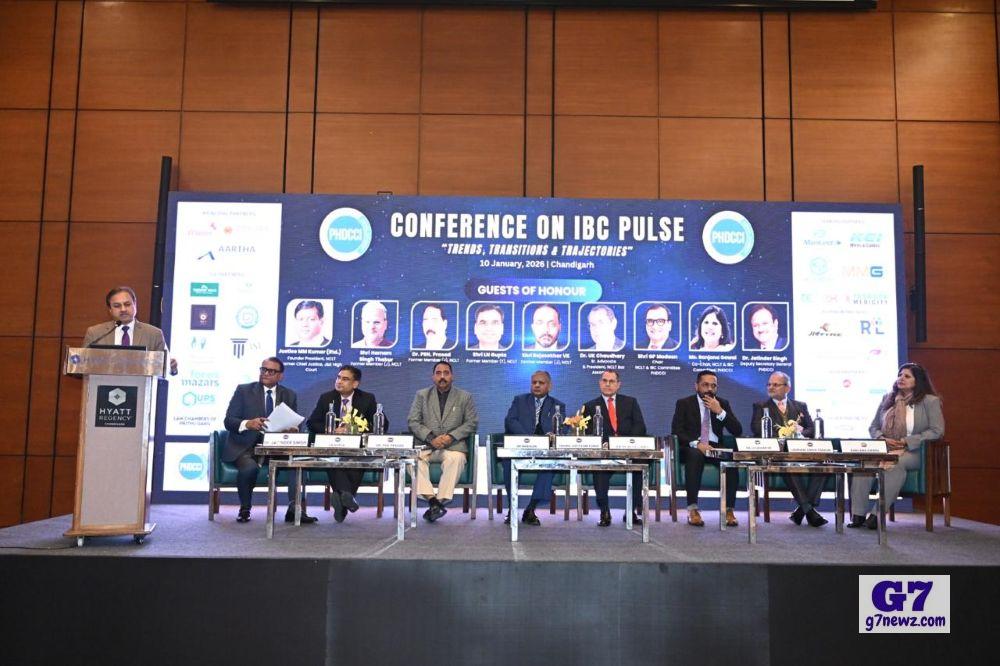
Justice Kumar further explained that the establishment of the NCLTs reflects a synthesis of constitutional values, legislative intent, and judicial experience. It represents a thoughtful effort by the State and Parliament to harmonise the law with the evolving economy and real market conditions.
In his welcome address, GP Madaan, Chair of the PHDCCI NCLT & IBC Committee, observed that insolvency resolution and the IBC have become complementary pillars of India’s corporate framework. He emphasised the urgent need to increase the number of NCLT benches and strengthen infrastructure to cope with rising caseloads. He also announced that PHDCCI would continue to organise similar programmes to enhance awareness and understanding of the NCLT and IBC framework.
Earlier, Dr. Jatinder Singh, Deputy Secretary General, PHDCCI, outlined the objectives of the conference and highlighted its focus on policy dialogue, judicial developments, and practical challenges in insolvency resolution.
Speaking during the deliberations, Harnam Singh Thakur, former Judicial Member of the NCLT, supported the call for increasing the number of benches and members, along with upgrading basic infrastructure, to reduce pendency and industrial disputes. He described the IBC as one of India’s most significant economic reforms and stressed the need for continuous refinement of the framework to address emerging challenges within prescribed timelines.
Senior Advocate and President of the NCLT Bar Association, Dr. U K Chaudhary, pointed out that judicial processes cannot always be strictly time-bound, as courts must hear all aspects to ensure justice. He advocated for more practical timelines and noted that while the Companies Act, 2013, provides for 63 NCLT members, the volume of IBC petitions is several times higher than traditional company matters.
In his address, Rajshekhar V.K., former Judicial Member of the NCLT, remarked that the existing infrastructure was designed based on the original strength of members at the time of NCLT’s formation, and substantial changes are now required to meet present demands.
Dr. P.S.N. Prasad, former Judicial Member of the NCLT, emphasised that introducing pre-institutional mediation within the IBC framework through meaningful and practical reforms would enhance efficiency and improve overall outcomes of the insolvency process.
Highlighting the economic impact of the IBC, L.N. Gupta, former Member of the NCLT, stated that nearly 87 percent of cases have been successfully resolved. He added that over the past nine and a half years, the IBC has helped bring back approximately ₹19 lakh crore into the Indian economy, making it one of the most effective contributors to economic recovery among judicial mechanisms.
In the panel discussion, the participants, Anand Chibbar, Krishan Singh Barguzar, Dr Vandana Arora, Anil Katia, Shekhar Raj Sharma, and Jalesh Kumar Grover spoke on CIRP in transition- judicial developments and emerging trends.
The session focused on the evolving framework of the Personal Insolvency Resolution and Bankruptcy Process with the participation of Mohit Chawla, MSatish Bijarniya, Apoorv Agarwaland Prithu Garg. While in the third session, the participants, namely Atul Sood, KV Jain, Sanjeev Pandey, Pankaj Agarwaland Mukul Bansal, spoke about the liquidation under IBC-Practice and Emerging Developments.
The Co-Chairs of PHDCCI NCLT & IBC Committee, Ms Ranjana Gawai, Abhishek Anand, Rachit Mittal and Harish Taneja moderated the panel discussions. More than 200 delegates attended the conference.


