


“The specialised waterproofing industry in India has already reached a market size of ₹15,000 cr and is fast-tracking to cross the $2 billion milestone” said Durga Shanker Mishra (Former Secretary, Ministry of Housing & Urban Affairs, Govt. of India, and Former Chief Secretary of Uttar Pradesh) while inaugurating the second edition of the India International Waterproofers Conference & Expo 2026.
Organised by The Waterproofers Association of India (WAI), the flagship two-day summit features over 20 industry speakers, five targeted panel discussions, and an expansive exhibition with 53 specialised live-demonstration booths.
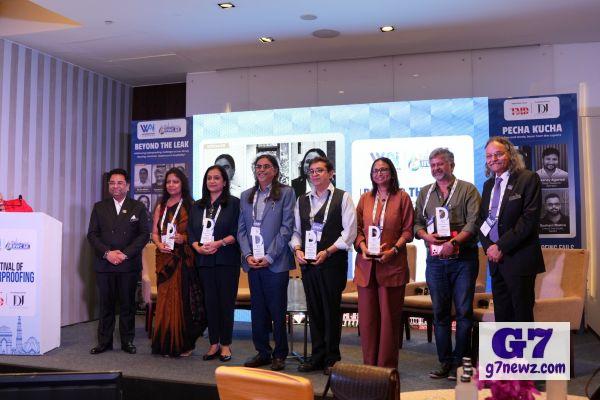
As we progress toward the national vision of a Viksit Bharat 2047, our construction technology sector must aggressively catch up with frontline manufacturing segments,” Mishra stated. “We can no longer design structures for a short 10-to-20-year window; our infrastructure must be built to last for 100 years. By studying our ancient heritage wisdom, where temples and historic monuments have stood strong for over 1,000 years, we must shift our priority away from cheap initial material costs and focus heavily on total structural lifecycle sustainability.”
Sandeep Chaudhry, President of WAI and Founder of SNP Technologies Pvt. Ltd. and DryShield Waterproofing, reflected on the journey of mobilising an organised, national technical fraternity. “Waterproofing functions as the silent protector of all building systems and heavy public infrastructure, yet it remains the most commonly ignored or under-budgeted segment,” Chaudhry said. “Real estate assets frequently witness crores spent on high-end interior finishes and architectural aesthetics, while the core structural envelope is left vulnerable to devastating moisture ingress. WAI was established to completely reform this culture. We do not sell products; we deliver engineering confidence through technical skill certification, refined applicator training, and robust specification standards to achieve a leak-free India.”
Hu Xibao, Chairman of the China Building Waterproof Association (CWA), highlighted China’s robust $16 billion waterproofing sector and extended a strategic invitation to Indian firms for cross-border development. “India is in a golden era of accelerated urban development,” Hu noted. “Chinese partners stand ready to supply smart, automated execution tools tailored specifically to handle India’s high-temperature zones and streamline site procedures to boost ground-level efficiency.”
The landmark global summit, hosting 55 international delegates from nations including China, Korea, Germany, and the UAE, marks an essential paradigm shift across India’s broader construction and real estate sectors: moving rapidly from low-cost, ad-hoc waterproofing installations toward sophisticated, climate-resilient structural engineering, emphasising the rapid commercial escalation of the domestic building chemical supply chain.
Reinforcing the technical focus of the event, Prof. Mahesh Tandon, Chairman of Tandon Consultants Pvt. Ltd., stressed the indispensable value of human expertise over basic field automation.
“Our historical engineers did not have access to modern high-speed computing, yet they possessed unparalleled engineering judgment,” he remarked. “Successfully mitigating severe hydrostatic pressure in modern high-rise basements or complex transit tunnels requires a deep, fundamental understanding of water dynamics against concrete structures, rather than an over-reliance on automated specifications.”
A technical presentation by Mehul Parikh (Advisor to Pidilite Industries & Principal Consultant at EnvaDure) outlined the severe impact of shifting weather patterns on modern construction envelopes.
“We are building complex 21st-century architectural masterpieces with outdated 20th-century waterproofing specifications,” Parikh warned. He highlighted India’s 15-fold increase in extreme heatwaves and a 1.4-times surge in concentrated rainfall, urging a complete pivot toward climate-resilient engineering. He strongly recommended multi-action thermal insulation, over-deck spray polyurethane foam, and vegetative green roofs engineered to withstand 65°C Indian roof surface temperatures. Parikh asserted that primitive water ponding tests are no longer adequate, demanding rigorous scientific testing and shared accountability among manufacturers, contractors, and asset owners.
Day one of the conference featured technical sessions on sub-grade basement engineering, bottom-up and top-down confined wall systems, and chemical containment structures for public utilities like sewage treatment plants (STPs) and desalination facilities. Specialised roundtables organised in collaboration with NAREDCO addressed the underlying design, tendering, and supervision flaws that lead to systemic waterproofing failures.
The summit continues tomorrow, August 7, with technical sessions exploring automated liquid membrane applications, advanced pre-cast construction joints, PU/Epoxy injection techniques for tunneling networks, and AI-driven business automation platforms for scaling engineering enterprises.


