

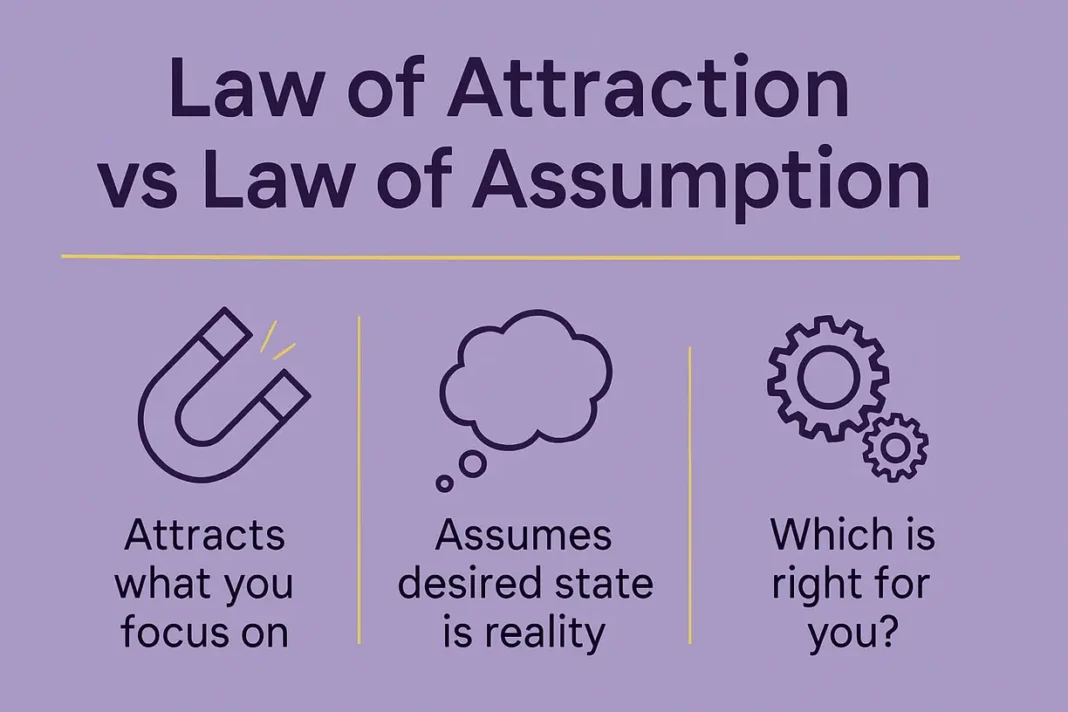

The real difference between the Law of Assumption and the Law of Attraction is this: Attraction focuses on what you feel, while Assumption focuses on what you accept as true about yourself and your reality.
In 2026, two manifestation concepts dominate online searches: Law of Attraction and Law of Assumption. Many people use them interchangeably. Others claim one works better than the other.
So what is the real difference between the Law of Assumption and the Law of Attraction?
This guide explains both clearly, practically, and without exaggeration. You will learn:
-
What the Law of Attraction means
-
What the Law of Assumption means
-
Key differences between them
-
Which one works better
-
How to apply them step by step
-
Realistic expectations
Let’s break it down.
What Is the Law of Attraction?
The Law of Attraction is based on the idea that “like attracts like.” It suggests that your thoughts and emotions attract similar experiences into your life.
Core principles:
-
Positive thoughts attract positive outcomes
-
Negative thoughts attract negative outcomes
-
Emotional vibration influences results
Common Law of Attraction practices include:
-
Visualization
-
Affirmations
-
Gratitude journaling
-
Vision boards
The focus is on emotional alignment. If you feel abundant, you attract abundance.
What Is the Law of Assumption?
The Law of Assumption, popularized by Neville Goddard’s teachings, states that whatever you assume to be true becomes your reality.
It focuses less on emotion and more on belief.
Core principle:
Your assumptions about yourself and others shape your experience.
If you assume:
-
“I am successful,” you act accordingly.
-
“People respect me,” you behave confidently.
-
“I am chosen,” your energy shifts.
The Law of Assumption emphasizes identity and belief over vibration.
Law of Assumption vs Law of Attraction: Key Differences
Let’s compare them clearly.
1. Focus
Law of Attraction focuses on feelings and vibration.
Law of Assumption focuses on belief and identity.
Attraction says: Feel it to receive it.
Assumption says: Assume it to experience it.
2. Emotional Requirement
The Law of Attraction often teaches that you must maintain high emotions.
The Law of Assumption does not require constant positivity. It emphasizes persistence in belief even when emotions fluctuate.
3. Identity vs Desire
Law of Attraction focuses on what you want.
Law of Assumption focuses on who you believe you are.
Identity-based change tends to create deeper behavioral shifts.
4. Handling Doubt
In Law of Attraction, doubt is often seen as lowering vibration.
In Law of Assumption, doubt is normal. The key is returning to the chosen assumption consistently.
Which One Works Better in 2026?
Neither works magically. Both operate through psychology.
Manifestation works through:
Belief → Behavior → Results.
The Law of Attraction helps improve emotional state.
The Law of Assumption helps upgrade identity.
Many people see stronger long-term results with identity-based change because behavior follows identity automatically.
However, combining both can be powerful.
Step-by-Step: How to Use Law of Attraction Effectively
If you prefer Law of Attraction, follow this structure:
Step 1: Clarify Your Goal
Be specific about what you want.
Step 2: Practice Daily Gratitude
Gratitude shifts focus toward abundance.
Step 3: Visualize Calmly
Imagine the outcome for 5 minutes daily.
Step 4: Take Aligned Action
Emotion alone is not enough.
Step 5: Reduce Negative Self-Talk
Catch and replace limiting thoughts.
Consistency matters more than perfection.
Step-by-Step: How to Use Law of Assumption Effectively
If you prefer Law of Assumption, focus on identity.
Step 1: Identify Your Current Self-Concept
What do you believe about yourself?
Step 2: Choose a New Identity
Example: “I am confident and capable.”
Step 3: Persist in the Assumption
Even if evidence is limited, act as if it is true.
Step 4: Align Your Behavior
Speak, decide, and act according to the new belief.
Step 5: Repeat Daily
Repetition strengthens neural pathways.
Identity shifts create automatic behavioral change.
Real Results: What Actually Changes?
When practiced realistically, both methods can lead to:
-
Increased confidence
-
Clearer decision-making
-
Improved communication
-
Better opportunities
-
Stronger discipline
External results follow internal alignment.
Manifestation is not about controlling reality. It is about upgrading mindset and behavior.
Real Results: What Actually Changes?
When practiced realistically, both methods can lead to:
-
Increased confidence
-
Clearer decision-making
-
Improved communication
-
Better opportunities
-
Stronger discipline
External results follow internal alignment.
Manifestation is not about controlling reality. It is about upgrading mindset and behavior.
Common Myths About Both Laws
Myth 1: You Must Be Positive All the Time
Emotions fluctuate. Consistency matters more.
Myth 2: Thoughts Instantly Create Reality
Action and environment still matter.
Myth 3: One Technique Is Magical
Neither overrides skill, effort, or timing.
Which Should Beginners Choose?
If you are new:
Start with identity work from the Law of Assumption.
It is easier to maintain belief in who you are becoming than to force constant positive emotion.
You can then add gratitude and visualization from the Law of Attraction


